Tutorial 2 : using the qmat.nodes module
📜 The NodeGenerator class from qmat.nodes allows to generate sets of quadrature nodes associated to various types of orthogonal polynomials. It is based on the book of W. Gautschi :Orthogonal Polynomials: Computation and Approximation.
Gauss quadrature approximate integrals by a given quadrature rule on \(M\) points :
where \(f(t)\) is a function of interest, \(\omega(t)\) a weight function and \(\tau^M_m, \omega^M_m\) are the quadrature nodes and weights associated to the Gauss quadrature on \(M\) points. In particular, the quadrature nodes \(\tau^M_m\) are the roots a given polynomial belonging to an orthogonal basis with respect to the scalar product :
This polynomial basis is solely determined by the weights function \(\omega(t)\), and classical polynomial basis exist already in the literature :
\(\omega(t) = 1\) : Legendre polynomials
\(\omega(t) = \frac{1}{\sqrt{1-t^2}}\) : Chebyshev polynomials of the 1st kind
\(\omega(t) = \sqrt{1-t^2}\) : Chebyshev polynomials of the 2nd kind
\(\omega(t) = \frac{\sqrt{1+t^2}}{\sqrt{1-t^2}}\) : Chebyshev polynomials of the 3rd kind
\(\omega(t) = \frac{\sqrt{1-t^2}}{\sqrt{1+t^2}}\) : Chebyshev polynomials of the 4th kind
Node generation
The type of polynomial defines a node type, and the roots of the \(M^{th}\) degree polynomial of this type are then the quadrature nodes \(\tau^M_m\) and can be generated, e.g for \(M=4\) :
[1]:
from qmat.nodes import NodesGenerator

gen = NodesGenerator(nodeType="LEGENDRE", quadType="GAUSS")
nodes = gen.getNodes(nNodes=4)
print(nodes)
[-0.86113631 -0.33998104 0.33998104 0.86113631]
💡 Note that those nodes symmetrically distributed, which is not necessarily the case for other types of nodes e.g for the Chebyshev polynomials of the fourth kind :
[2]:
gen = NodesGenerator(nodeType="CHEBY-4", quadType="GAUSS")
nodes = gen.getNodes(nNodes=4)
print(nodes)
[-0.93969262 -0.5 0.17364818 0.76604444]
Different types of nodes are available, checkout qmat.nodes.NODE_TYPES for the current list, in particular :
LEGENDRE: for Legendre polynomialsCHEBY-1: for the Chebyshev polynomials of the first kindCHEBY-2: …
💡 You may noticed that those nodes are always strictly included in \([-1,1]\), hence usually named Gauss points. But four specific quadrature types can be considered for each node type (i.e for each polynomial basis) :
GAUSS: nodes do not include \(-1\) or \(1\),LOBATTO: nodes include \(-1\) and \(1\),RADAU-LEFT: nodes include \(-1\) (usually called Radau-I),RADAU-RIGHT: nodes include \(1\) (usually called Radau-II).
The quadrature type is selected when instantiating the node generator, as for the node type :
[3]:
gen = NodesGenerator(nodeType="LEGENDRE", quadType="LOBATTO")   # usually called Gauss-Lobatto in the literature
nodes = gen.getNodes(nNodes=4)
print(nodes)
[-1. -0.4472136 0.4472136 1. ]
[4]:
gen = NodesGenerator(nodeType="CHEBY-3", quadType="RADAU-LEFT")
nodes = gen.getNodes(nNodes=4)
print(nodes)
[-1. -0.42720716 0.36290645 0.92144357]
📣 We use the naming convention
RADAU-RIGHT/RADAU-LEFTas it is more explicit than the usual one in the literature, and also because Radau-I and Radau-II nodes are usually associated to the Legendre polynomials.
Orthogonal polynomials
The node computation process relies on the three term recurrence coefficients associated to each polynomial basis :
Those coefficients are know analytically for each polynomial basis (i.e node type), and are used to generate the tri-diagonal Jacobi matrix for the weight function \(\omega\)
Computing the eigenvalues of the leading principal sub-matrix of size \(M\) allows to retrieve the GAUSS nodes, and some small modifications of this sub-matrix allow to retrieve the LOBATTO, RADAU-LEFT and RADAU-RIGHT nodes.
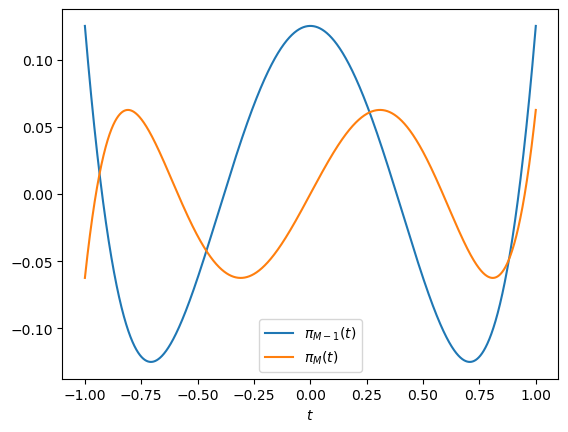
But one can also use the orthogonal coefficients to evaluate the orthogonal polynomial of any degree, e.g for \(M=5\) :
[5]:
import numpy as np
import matplotlib.pyplot as plt

degree = 4

t = np.linspace(-1, 1, num=10000)

gen = NodesGenerator("CHEBY-1")
alpha, beta = gen.getOrthogPolyCoefficients(degree+1)

pi1, pi2 = gen.evalOrthogPoly(t, alpha, beta)

plt.plot(t, pi1, label=r"$\pi_{M-1}(t)$")
plt.plot(t, pi2, label=r"$\pi_{M}(t)$")
plt.legend(); plt.xlabel("$t$");
📣 Note that the
quadTypeargument does not matter when generating orthogonal polynomials, and can simply be left to its default value.